In the Physics Olympiad, India achieved a golden triumph.
India again claimed a golden triumph at the 2026 Physics Olympiad. I am proud to share that India won 5 gold medals at the 56th International Physics Olympiad 2026 in Colombia and tied for first place with Russia, China, Kazakhstan, South Korea, and Taiwan.
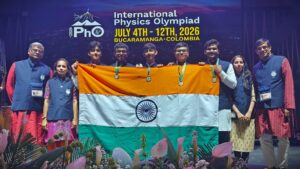
Five gold medallists from the 56th International Physics Olympiad (IPhO) 2026, held in Bucaramanga, Colombia, have propelled India to the top. 1. It is the second time that India has achieved a clean sweep at the Olympiad. These students competed against 381 students from 87 countries, making the result a significant achievement for the country. It was indeed India’s golden triumph again in 2026. The country is proud of their achievements.
The Indian gold medal winners are
- Kansisk Jain from Pune,
- Riddhesh Anant Bendale from Indore,
- Rishit Garg from Delhi,
- Shresth Suraiya from Mumbai,
- Svait Joshi from Ahmedabad.
Their performance was not just about medals; it reflected near-perfect scores in both theory and experimental tasks against 381 students from over 85 countries. For a competition widely regarded as one of the toughest, a five-gold finish signals exceptional focus, problem-solving spirit, experimental skill, and mental stamina. These students were indeed prepared to face this challenge and make India proud at the Physics Olympiad. It was indeed India’s golden triumph again in 2026.
India is also proud of the teachers, guides, and other staff who assisted, motivated, and counseled them. Because of their support, India won the Physics Olympiad 2026.
Professor Anwesh Mazumdar of HBCSE-TIFR, Dr. Leena Joshi, and scientific observers Professor Ananda Dasgupta of IISER Kolkata and Ms. Nisha Kelkar guided the students. Their mentoring and support played a vital role in the team’s success.
This was India’s 27th time competing. So far, around 44% of Indian participants have secured gold medals, while 41% have won silver. Additionally, 10% have been awarded bronze. Over the last decade, every Indian student who has participated has won a medal.
381 students competed from 85 countries.
In India, more students are eagerly preparing for the Physics Olympiad examinations and competing on a global stage. They are preparing seriously for the test, staying focused, and are determined to win. This winning spirit, along with the strong support students receive from faculty members, has put them in the box of success. This is why India finds triumph in the Physics Olympiad.
India’s 2026 performance can be seen as a repeat of 2025.
2026 was India’s golden triumph in the Physics Olympiad once again. This reflects the growing strength of its students being groomed in science and mathematics at the international level. Sharing the top rank with countries known for strong science education systems highlights the quality of preparation and commitment behind the Indian team’s success.
Around 40,000 to 50,000 students begin their Physics Olympiad journey through the National Standard Examination in Physics. Leading physics professors then provide further training to successful candidates. Every candidate’s primary goal is to succeed in the Physics Olympiad! It would indeed be India’s golden triumph again!
The Homi Bhabha Centre for Science Education (HBCSE), under the Tata Institute of Fundamental Research (TIFR) and the Department of Atomic Energy, manages the Physics Olympiad program. Their dedication motivates participants to qualify for the final Physics Olympiad tests. They are indeed successful! The outstanding results at the Physics Olympiad speak for themselves!
The achievement reflects decades of investment in scientific temperament, education, and talent development.
These achievements show that young India can produce world-class talent with adequate training.
Because of this training, selected students earn the position. This is how India triumphs in the Physics Olympiad.
History of the Olympiad
The first Olympiad happened in 1959 in Poland, and the subject was mathematics. That same year, Poland established the International Mathematical Olympiad.
In 1967, Eastern Bloc countries decided to set up the International Physics Olympiad. It was organized by Czesław Ścisłowski.
Prior to the competition, all Central European countries—Bulgaria, Czechoslovakia, Hungary, Poland, and Romania—participated. Each country sent a delegation of three students and one supervisor. Already in this first edition, the competition consisted of two exams, one theoretical and one experimental, and the students went on excursions while their exams were marked.
The organizers had devised the following rules for awarding medals. The top 8% of participants received a gold medal, the top 25% received a silver medal, and the top 50% received a bronze medal. The participant with the highest score receives a special prize, in addition to a gold medal.
Selection process at the Physics Olympiad:
At the national level, each delegation consists of at most five student competitors and two leaders. Observers may also accompany a national team. Students compete individually and must sit for intensive theoretical and laboratory examinations. For their efforts, the students can be awarded gold, silver, or bronze medals or an honorable mention.
Physics Olympiad Examination Structure:
The theoretical examination lasts 5 hours and consists of three questions. These questions usually have multiple parts. The practical examination may consist of one five-hour laboratory examination or two examinations that together take the full five hours.
India’s Olympiad Pathway:
India’s selection process follows a rigorous five-stage program coordinated by the Indian Association of Physics Teachers (IAPT) and the Homi Bhabha Centre for Science Education (HBCSE). Then finally:
- Stage 1: National Standard Examination in Physics (NSEP)
- Stage 2: Indian National Physics Olympiad (INPhO).
- Stage 3: Orientation Cum Selection Camp (OCSC) at HBCSE, Mumbai.
- Stage 4: Pre-Departure Training (PDT) for selected team members.
- Stage 5: Final participation in the International Physics Olympiad
Thus, the top students appear for the examination.