
One of the most important items that is required by many almost daily is soap. It is used especially for cleansing, to wipe off dirt and bad odour from one’s body, thereby keeping one’s body free from skin rashes and other skin diseases.
Soap is for hygiene, and its use can be found in ancient texts such as the Manu Smriti and the Sushruta Samhita. In the Medieval documents, there is a reference to an alkaline paste made from wood ashes and oils for cleaning.
Substances like Reetha (soapnuts), Shikakai (fruit pods), and Amla (gooseberry) were used for hair and body. Natural ingredients such as turmeric, sandalwood, neem, and Multani Mitti (Fuller’s Earth) were popular for their therapeutic and exfoliating properties.
During the British era, the British product Lever Brothers was dominant in British India. The iconic red soap was the only variety available at the time. These were imported from England and marketed in India. By 1897, Mr Jamshedji Tata was the first Indian to manufacture soap in Meerut, Uttar Pradesh. It was called the North West Soap Company.
During the struggle for Independence, India witnessed a surge in “Make in India “soaps. The word “Swadeshi” was the buzzword then, and many tried to manufacture native soap.
In 1916, during World War I, Maharaja Nalwadi Krishnaraja Wadiyar and Sir M. Visvesvaraya established a Soap Factory in Bangalore to produce the world’s only 100% pure sandalwood oil soap.
In 1918, the first indigenous soap unit was established by Jamshedji Tata when he purchased OK Coconut Oil Mills in Kerala.
The first branded soaps appeared in the 1930s. Not to be left behind, in 1919, Ardeshir Godrej launched CHAVI, a soap from vegetable oils instead of animal fats, and it was endorsed by Rabindra Nath Tagore himself
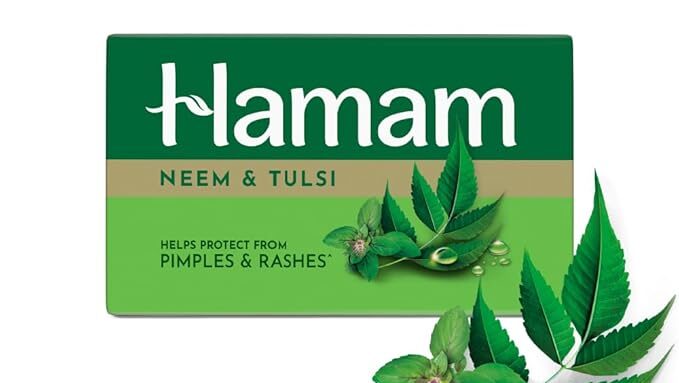
For a long time, one of the most popular soap brands has been HAMAM. It’s a desi brand with large followers and been in the market since the Raj. It is marketed by the Indian unit of Unilever. It was previously owned by Tata Sons.
Hamam came into the market as early as in 1931 and soon became popular among the native Indians. It proved suitable for rashes, pimples and body odor.
It was prepared from natural ingredients. It has Neem, Tulsi and Aloe Vera which gave protections to skin problems even doctors recommended use of this soap. Neem has its antibacterial qualities, which help fighting germs. Tulsi has anti-inflammatory properties that benefits and helps in soothing irritated skin. Aloe vera is a natural moisturizer there by hydrating the skin prevent dryness. Therefore, the combination ensures that Hamam soap not only cleanses but also nurtures and heals the skin.
Hamam is a herbal product and this ensures its safe use on human’s body’. Chemicals cause skin rashes and other skin related issues. People are now educated and prefer herbal products contrary to other dazzling stuff with artificial products. Then comes the advertisement which lure people easily.
Hamam has survived for long for it’s a product that has public’s trust though many foreign products have entered in the market and Hamam has survived. Not only that it has diversified too.
Dr. VP Sidhan in his kitchen to treat skin ailments of railway workers made a soap Medimix in 1969 and is still considered a better option for treating skin rashes.
In 1902-03, a Bengali Abani Mohon Ghose who had gone to New York at Pratt Institute of Technology for higher studies picked up the art soap-making and set up a factory at 4 Raj Kumar Chatterjee Street on Tala Park Avenue in North Kolkata. He also wrote a book, Chemical Technology of Oil, Fats and Manufactured Products, which was published by D. Van Nostrand from New York. It was called the Bengal Soap.
In 1916, another factory, the Calcutta Chemical Company in Kolkata, was set up by K.C. Das, B.N. Maitra, and R.N. Sen. The spirit of the Swadeshi movement was the foundation of this company as well. Khagendra Chandra Das (later known as K.C. Das) came from an affluent family in Bengal. Son of Rai Bahadur Tarak Chandra Das, a Judge and Mohini Devi, a Gandhian and Independent activist. After completing his education, Khagen became a lecturer at Shibpur College (now called The Indian Institute of Technology, Shibpur). The freedom movement was strong then, and Khagen, too, was engulfed in the fire. His father learned that the British would arrest Khagen. His father didn’t want him here, and to avoid being arrested, he sent his son abroad for higher studies. Khagen chose America and soon set sail to study at U C Berkeley. Later on, with S.M. Bose, he came to Stanford University, and his subject was Chemistry. Having passed the examination, both returned to India. Along with B.N.Maitra and R.N. Sen, they set up a factory at 35 Panditia Road. The company is best known for manufacturing Margo soap, Neem Toothpaste, and Lavender Dew Powder.
The soap industry is now worth $17 billion, and many brands have emerged. With aggressive branding by leading personalities, the soap industry is a force to be reckoned with. Not to be left out, Indian Ayurveda has also jumped into the fray and is performing well.